In 2025, the conversation around AI agents was dominated by cloud deployments. Massive data centers, API calls, and centralized orchestration. But a quiet revolution has been brewing at the edge of the network — and in 2026, it has reached a tipping point. AI agents are now running on smartphones, industrial sensors, autonomous vehicles, and even microcontrollers, delivering capabilities that were once impossible without a constant cloud connection.
This shift isn't just about convenience. It represents a fundamental rethinking of where intelligence should live, driven by three forces: the demand for real-time responsiveness, the imperative of data privacy, and the economics of scale. When your agent needs to make a decision in 20 milliseconds, when your data cannot leave the device, or when you're deploying to thousands of locations with unreliable connectivity, the cloud becomes a liability. The edge becomes the answer.
The Edge Advantage: Why Local Beats Cloud
The case for edge deployment rests on four pillars, each compelling enough on its own, but devastating in combination.
Latency is the most obvious. A cloud round-trip adds 100-500 milliseconds to every inference. For a customer service chatbot, that's acceptable. For an autonomous vehicle navigating traffic, a robot on a factory floor, or an AR application overlaying information on the physical world, it's fatal. Edge agents respond in tens of milliseconds because there's no network hop — the model runs where the data is generated.
Privacy is the most legally compelling. When data never leaves the device, it cannot be intercepted in transit, exposed in a breach, or subject to jurisdictional disputes. For healthcare applications under HIPAA, financial services under GDPR, or any organization handling sensitive personal information, edge deployment transforms compliance from a complex legal challenge into a technical guarantee.
Cost is the most economically compelling. Cloud inference is priced per token or per request. At scale, those costs compound relentlessly. Edge deployment involves a one-time hardware cost and zero ongoing inference fees. For applications serving millions of users or operating continuously, the math is overwhelming. One analysis found that edge deployments reduced operational costs by 60% or more compared to cloud-only architectures.
Reliability is the most operationally compelling. Edge agents function without internet connectivity. In manufacturing plants with network dead zones, on oil rigs in remote locations, or in vehicles moving through tunnels, edge agents keep working. They buffer data locally and sync when connectivity returns. The system survives outages that would cripple cloud-dependent alternatives.
The Technology Stack: How Agents Fit on Small Devices
The idea of running a large language model on a smartphone would have seemed absurd two years ago. Today, it's routine. The transformation has been driven by three complementary advances.
Small Language Models (SLMs) have matured dramatically. Models in the 1B-4B parameter range now deliver capabilities that rival cloud models from 2024. Google's Gemma 4 edge variants, with effective parameter counts around 2B and 4B, fit in 1.5GB of memory and run on any device with 4GB of RAM. Microsoft's Phi-4-mini, at 3.8B parameters, handles structured reasoning tasks that once required models ten times larger. Meta's Llama 3.2 1B and 3B variants target mobile hardware directly.
Compression techniques have made these models even smaller. Quantization reduces the precision of model weights from 16-bit to 4-bit or even lower, shrinking memory requirements by 4x with minimal accuracy loss. Pruning removes unnecessary connections entirely. Knowledge distillation transfers capabilities from large teacher models to compact student models. Production workflows stack these techniques: prune first, then distill, then quantize for shipping.
Hardware acceleration has kept pace. Modern smartphones include Neural Processing Units (NPUs) specifically designed for AI inference. Qualcomm's Snapdragon chips run models like Phi-3 Mini and Llama 3.2 1B directly on the NPU, bypassing the CPU entirely. Apple's M-series chips provide efficient inference through CoreML. NVIDIA's Jetson modules bring datacenter-class inference to industrial edge devices. Google's LiteRT-LM, launched in April 2026, provides a production-grade framework for high-performance LLM deployment on edge devices.
The Architecture: Not Cloud or Edge, But Both
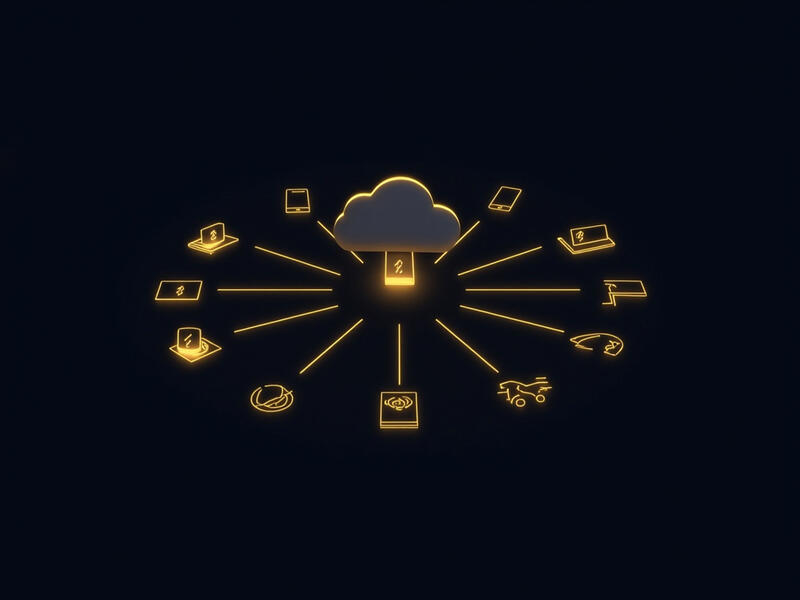
The most sophisticated deployments in 2026 aren't purely edge or purely cloud. They're hybrid architectures that leverage the strengths of each.
The edge handles real-time inference, immediate decision-making, and sensitive data processing. A factory floor agent detects defects in milliseconds. A healthcare agent analyzes patient data without transmitting it. A retail agent personalizes recommendations based on local purchase history.
The cloud handles model training, fleet management, and long-term analytics. Models are trained on aggregated, anonymized data from thousands of edge devices, then compressed and pushed back to the edge via over-the-air updates. The cloud provides observability across the entire fleet, version control for model updates, and the computational heavy lifting for periodic retraining.
This separation of concerns creates a virtuous cycle. The edge generates data that improves the cloud models. The cloud models become more capable and more efficient, enabling deployment to even more constrained edge devices. The system learns continuously without compromising privacy or latency.
Real-World Deployments: Where Edge Agents Are Working Today
The theoretical advantages of edge deployment are compelling. But the real proof is in production systems that are delivering value today.
Manufacturing
Manufacturing leads in adoption. Edge agents on production lines perform quality control at 120+ frames per second, detecting micro-fractures that human inspectors miss. They operate in network dead zones where cloud connectivity is unreliable. And they keep sensitive production data on-premises, addressing intellectual property concerns that make manufacturers deeply uncomfortable with cloud-only solutions.
Healthcare
Healthcare is rapidly following. Diagnostic agents run on medical devices, analyzing imaging data in real-time without transmitting patient information to external servers. In remote clinics with limited connectivity, edge agents provide diagnostic capabilities that would otherwise require specialist visits. The privacy guarantees of edge deployment align perfectly with healthcare's regulatory requirements.
Automotive
Automotive has been an early adopter out of necessity. Autonomous vehicles cannot depend on cloud connectivity for safety-critical decisions. Edge agents handle perception, path planning, and control entirely on-board. The cloud handles map updates, fleet learning, and long-route optimization, but the vehicle must function safely even with zero connectivity.
Retail
Retail is deploying edge agents for inventory management, loss prevention, and customer analytics. Cameras with on-device processing detect stockouts, analyze foot traffic patterns, and identify suspicious behavior — all without transmitting video footage to the cloud. This addresses both privacy concerns and bandwidth costs.
Financial Services
Financial services are exploring edge agents for fraud detection and customer service. Local models handle routine transactions and balance inquiries without cloud round-trips. Sensitive financial data remains on the customer's device or within the bank's infrastructure.
The Challenges: What Edge Deployment Doesn't Solve
Edge deployment is not a panacea. The challenges are real, and organizations need to address them honestly.
Model capability remains the fundamental constraint. Even the best small models cannot match the reasoning depth of frontier cloud models. For complex multi-step reasoning, creative tasks, or applications requiring broad world knowledge, cloud models remain superior. The gap is narrowing, but it hasn't closed.
Update management is operationally complex. Cloud models update instantly — deploy a new version and every user gets it immediately. Edge models require over-the-air updates to thousands or millions of devices, with version compatibility, rollback mechanisms, and bandwidth considerations. The logistics are manageable but non-trivial.
Observability is harder. When models run in the cloud, you have complete visibility into every inference. When they run on edge devices, you lose that visibility. Debugging requires local logging, telemetry that respects privacy, and synthetic testing that catches issues before deployment.
Hardware fragmentation complicates development. The edge device landscape is incredibly diverse — different chip architectures, memory constraints, operating systems, and capabilities. A model optimized for one device may not run efficiently on another. Frameworks like ONNX Runtime and TensorRT help, but cross-platform deployment remains harder than cloud deployment.
The Road Ahead: What's Coming in the Next 18 Months
Several trends will accelerate edge agent adoption through 2027.
Multimodal edge models are emerging. The next generation of small models won't just process text — they'll understand images, audio, and video. Google's Gemma 4 edge variants already support image input at the 2B scale. As these capabilities mature, edge agents will handle richer, more complex inputs without cloud assistance.
Agent-to-agent protocols at the edge will enable local coordination. The Model Context Protocol (MCP) and Agent-to-Agent (A2A) protocols, already standard in cloud deployments, are being adapted for edge environments. Edge agents will discover and coordinate with each other locally, creating mesh networks of specialized agents that collaborate without central orchestration.
Federated learning will close the capability gap. Instead of training on centralized data, edge devices will train locally on their own data and share only model updates — not raw data — with a central server. This preserves privacy while allowing the collective model to improve from every device's experience. The result: edge models that get smarter over time without compromising user privacy.
Specialized silicon will push capabilities further. Next-generation NPUs and AI accelerators will enable larger models on smaller devices. The boundary between "edge-capable" and "cloud-only" models will continue to shift upward.
Key Takeaways
Edge deployment of AI agents in 2026 is not a niche concern for specialized applications. It's a mainstream architectural choice that organizations must consider for any deployment where latency, privacy, cost, or reliability matter — which is to say, for most deployments.
The winning architecture is rarely pure edge or pure cloud. It's a thoughtful hybrid that leverages the edge for real-time, sensitive, and offline-capable processing, while using the cloud for training, orchestration, and analytics. Organizations that master this hybrid will deploy agents that are faster, more private, more reliable, and more cost-effective than their cloud-only competitors.
The question is no longer whether to deploy agents at the edge. It's how quickly you can adapt your architecture to take advantage of it.
Published on SkillGen — the free AI agent skill creation tool. Build custom skills for your agents with visual tools, no coding required.